
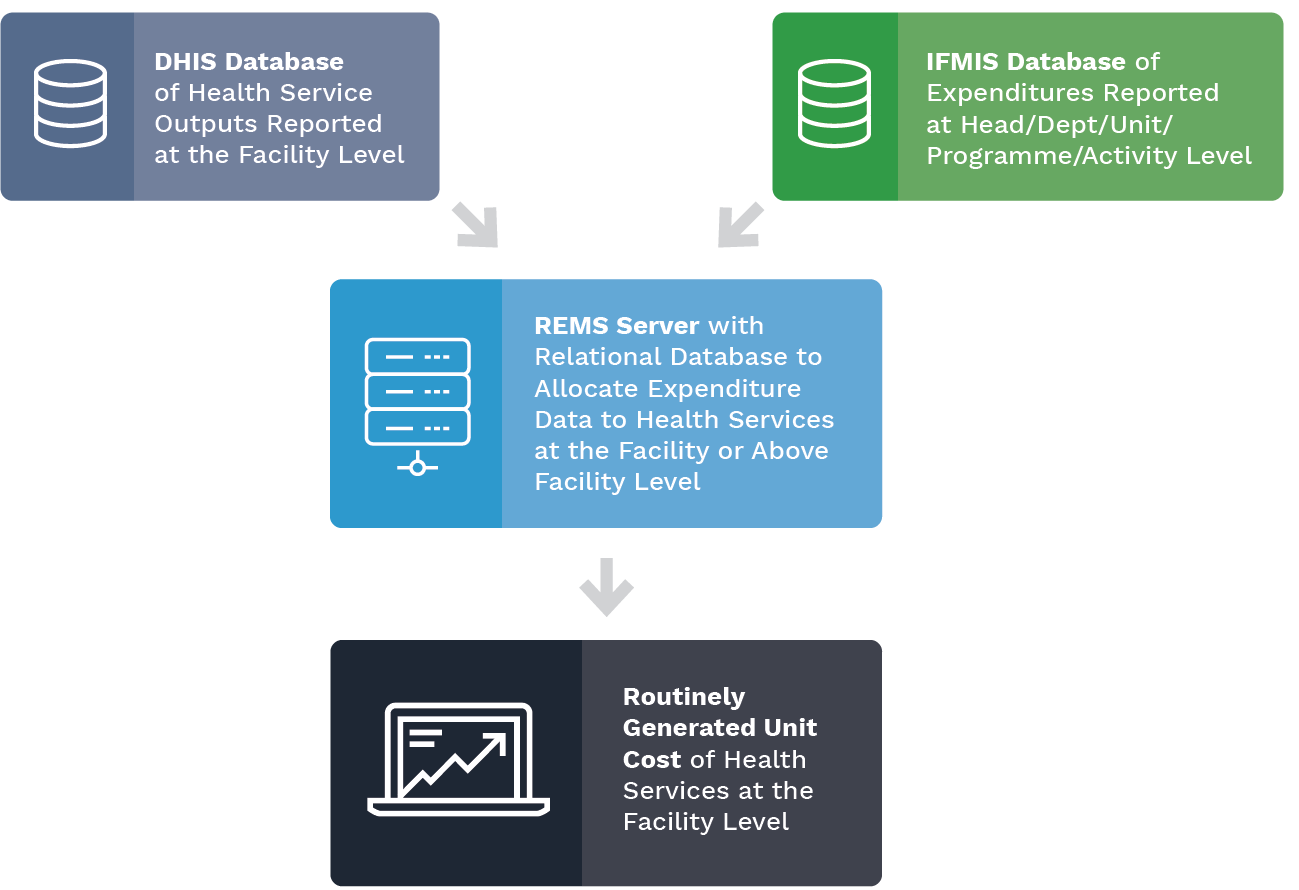
- REMS uses resource allocation matrices (RAMS), an FHI 360 innovation, to map existing HIV/AIDS expenditure data from resource providers to services at the point of care, or non-service uses above the facility level (administrative level).
- A RAM is a matrix of weights corresponding to the proportion of total expenditure expected to be used for each combination of input and service at a point of care or administrative level.
- Total expenditure at the point of care or administrative level is multiplied by the weights in the corresponding RAM, which results in total expenditure per service by type of input.
- The allocated expenditures are then divided by the M&E output data from DHIS 2.0 to estimate the resources used per unit of service at each point of care.
- REMS estimates are produced quarterly.
Links
RAMS: what they are and how they are used (PDF 205 KB)
Flowchart showing allocation rules for expenditures (PDF 80 KB)